Category: Uncategorized

  • Free Webinar: The first international Safety Instrumented Systems Conference online (SIScon Online) dated 1st Dec 2020

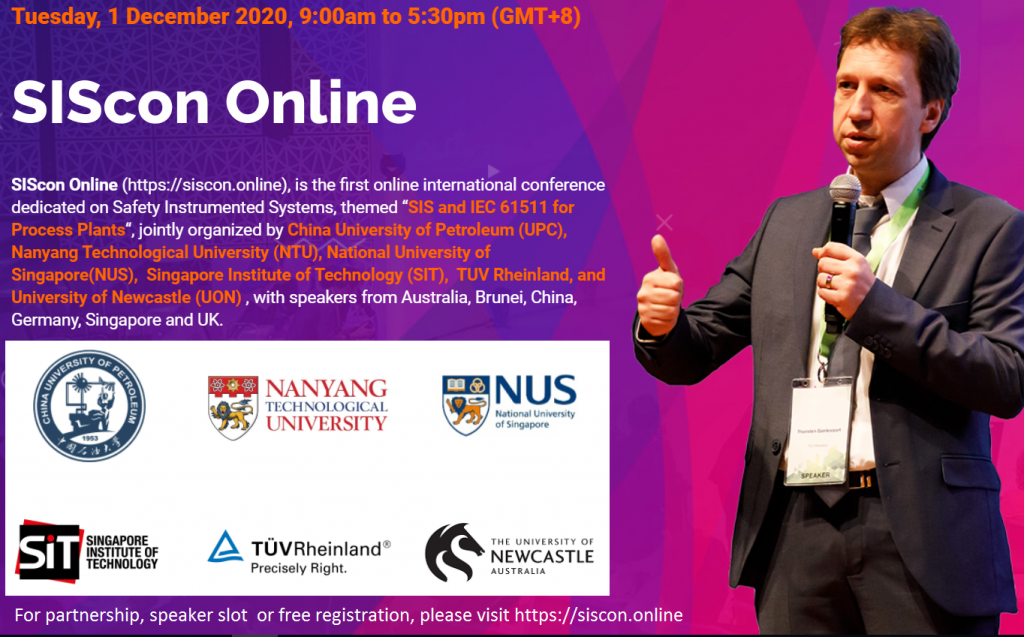
    We’d like to update that ,  SIScon Online,  the 1st International  Safety Instrumented System (SIS) Conference,  will be held on Tuesday, 1 December 2020, 9:00am to 5:30pm (UTC+8) @Webinar, themed “SIS and IEC61511 for Process Plants”, jointly organized and supported by China University of Petroleum (UPC), Nanyang Technological University (NTU), National University of Singapore (NUS), Singapore Institute of Technology (SIT), TÜV Rheinland and University of Newcastle (UON).

    We’d like to seek your support in

    1. Being a speaker, submit paper  by 31st Oct: https://siscon.online/call-for-papers/

    In addition,

    2. Being  participants (free, limited seats): https://go.tuv.com/SG20_I03_SISCON_RegistrationPage%20

    3. Being one sponsor: https://siscon.online/contact/


    More details can be found at below:

                 
    Background
    SIScon is the short form for “Safety Instrumented System (SIS) Conference”. SIS, as one state-of-art technology functional safety application in process sectors, is widely adopted globally. IEC 61511 is a technical standard that sets out requirements for the specification, design, installation, operation and maintenance of Safety Instrumented Systems (SIS), so that it can help achieve or maintain a safe state of the process.  

    SIScon is the first and only international platform dedicated on the collaboration of SIS and IEC 61511, through the sharing of technologies, methodologies, know-hows, standards and regulations. It intends to help and integrate all stakeholders of SIS and IEC 61511 globally. The stakeholders include plant/process operators, EPC, SIS integrators, safety element suppliers, Engineering Services Providers, SIS practitioners, Standard Development bodies, Regulators, Education and Research Institutes.  

    Who will attend:
    plant/process operators,
    EPCs,
    SIS integrators,
    safety element suppliers,
    Engineering Services Providers,
    SIS practitioners,
    Standard Development bodies,
    Regulators,
    Education and Research Institutes.

    Topics of Interest:
    SIS and Regulations for Process Industry
    SIS Safety Life-Cycle (SLC)
    HAZOP
    LOPA
    SRS
    SIL Study (Determination and/or Verification)
    Design and Engineering
    Installation, Commissioning and Validation
    Operation and Maintenance
    Modification
    Decommissioning
    IEC61511History and development Key Features
    Global adoption Application and Regulations
    Functional Safety Management
    Policy and strategy
    Organization and resources (competency management)  
    Risk evaluation and risk management
    Safety Planning
    Implementing and monitoring
    Functional Safety Assessment
    Functional Safety Audit and Revision
    SIS configuration management
    Documentations
    Other relevant topics, such as:
    Safety Element design and development
    Proven in Use
    Proof Testing
    Design for Safety
    Alarm Management
    Change Management
    Insurance Policy
    Cyber Security
     

  • Jeremy of TUV Rheinland Singapore: Continuous Support of Safety Services for Process Industries amid COVID-19

    Background:  COVID-19 is affecting every industry, including Process Industry’s Safety Management. SafetyCase.sg has recently conducted an interview with Jeremy Gan, one Business Development Executive of TUV Rheinland Singapore. In this interview, SafetyCase.sg intends to find out how the industry stakeholders can jointly combat COVID-19 situation in the aspects of Process Safety and Safety Case.

    SafetyCase.sg: Hi Jeremy, thank you for your time with us today. Can you tell me something about yourself?

    Jeremy : Hi SafetyCase.sg, it is my pleasure, thank you for the opportunity. I work in the Industrial Services team of TUV Rhineland Singapore mainly supporting Safety Assurance for the Process Industry. I consider myself extremely fortunate to have a chance to intern at TUV Rheinland Singapore back in 2018. It was in my short stint with TUV Rheinland that made me realise I am interested to contribute to the safety aspect of Singapore process industry, particularly in the aspect of Safety Case Regime.

    SafetyCase.sg : Can you elaborate more on TUV Rheinland’s services in support of Safety Case Regime?

    Jeremy: TUV Rheinland, originated in Cologne Germany in 1872, is with business focus in quality and safety. In Singapore, our industry services teams focus on Safety Services for the process industry in line with local regulations and best engineering practices.  With a rich experience of more than 400 Safety Case Projects done globally, we can support all aspects of Safety Case development in Singapore including MAPP, PHA, SHMS, EPP and QRA, as one registered QRA consultancy with NEA (National Environmental Agency). In addition, we support in Functional Safety (SIS/SIL/SIF) application for process industries according to IEC 61511 and Explosion Protection services in line with ATEX/IECEx.

    SafetyCase.sg : Can you name some of your clients and some project names you have conducted?


    Jeremy : I am sorry that I’m unable to share the project names to Non-Disclosure Agreement signed with companies. However, I can share some of our local client list includes regulatory body and industrial giant like EMA, Shell, Evonik, SRC, CPChem and so on.


    SafetyCase.sg : Does the COVID-19 affect the safety services for process industry  greatly in Singapore?


    Jeremy : Yes, indeed it does. However, we still offer continuous support for our clients to my best ability, though we have to reschedule some auditing jobs.


    SafetyCase.sg : How does your team manage to continuously support your clients?


    Jeremy : We tap on the advancement of technology, go digital and go remote.  As it is our utmost priority to ensure the well-being and safety of our customers and employees, with the support of the clients, we now conduct our services remotely by telecommuting and working from home.

    These services include Gap Analysis, Training, Auditing, Verification, Assessment and workshop in the aspects of Functional Safety (SIS/SIL/SIF), Safety Case (HAZOP/QRA/LOPA) and Explosion Protections (Atex/IECEx).

    Some examples are:

    Online Training of SIS according to IEC61511

    https://safetycase.sg/wp-content/uploads/2020/04/Training-on-SIS-according-to-IEC61511_TUV-Rheinland-Singapore.pdf


    Remote Support of Functional Safety:

    https://safetycase.sg/wp-content/uploads/2020/04/Remote-Support-IEC61511-SIS-Functional-Safety-TUV-Rheinland-Singapore.pdf


    SafetyCase.sg : Thank you, Jeremy. I appreciate your sharing and now I’m more confident that the process industry will manage its safety well with the support from your company and others. Any further comment from you?

    Jeremy: All stakeholders will need to work together amid this pandemic. While many companies scale down operation and reduce inter mingling, safety remains utmost paramount and cannot be compromised. We particularly seek the support and understanding of plant owner and companies that we will offer services remotely during these period of “circuit breaker”.


    SafetyCase.sg: Thank you, Jeremy. I look forward to seeing you next time.


    ===============================================================================


    Contact info:

    Jeremy Gan

    Business Development Executive for Industrial Services


    Functional Safety |Explosion Protection |Safety Case |Industrial CyberSecurity


    jeremy.gan@tuv.com

    Tel: +65 67990338

    H/P: +65 9170 9814

    Fax: +65 65628579


    TÜV Rheinland Singapore Pte. Ltd.
    25 International Business Park #01-57/58

    German Centre

    Singapore 609916.

    www.tuv.com

  • Proof Test of Safety Instrumented Systems (SIS) according to IEC61511

    Based on the presentation on Proof Test of Safety Instrumented Systems (SIS) according to IEC 61511 by Functional Safety Expert Mr. Chen Zhenkang of TUV Rheinland Singapore,  at the ASEAN HSSE conference dated  18th Sep 2019.

    1. Introduction: Process Industry & IEC61511The process industry sector, such as Refineries, Petrochemical, Pharmaceutical, Specialty Chemical, Semiconductor, Tank  Storage, Power Plants, Pulp and paper, Water Treatment, FPSO and other oil and gas platforms, is becoming increasingly reliant upon complex safety systems for safety management.IEC 61511 is a technical standard which sets out requirements for the specification, design, installation, operation and maintenance of Safety Instrumented Systems (SIS), so that it can be confidently entrusted to achieve or maintain a safe state of the process. Its latest revision is edition 2 ( 2016) with amendments.

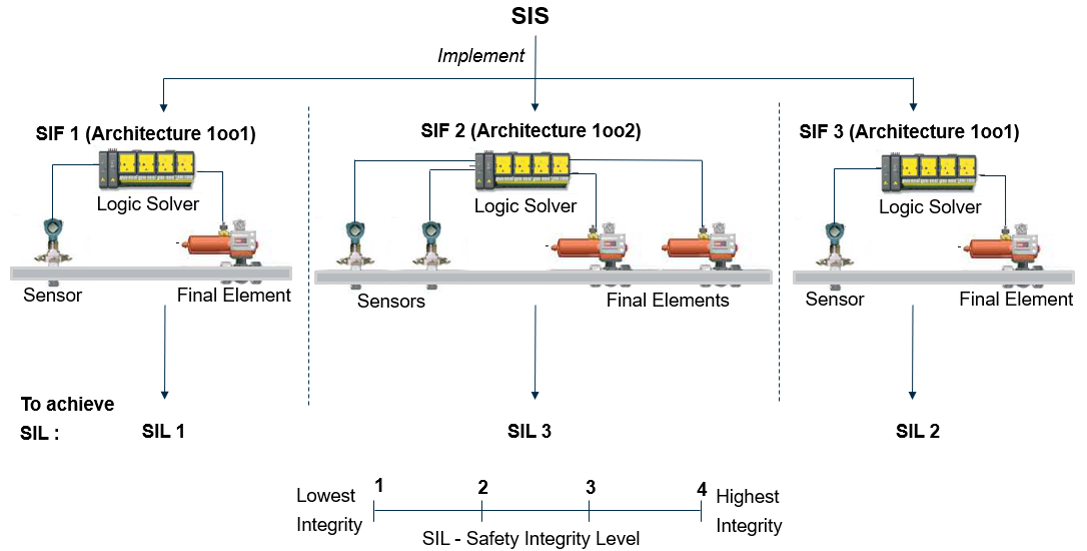
      3 important S-words in IEC 61511 are SIS, SIF and SIL.

      SIS: Safety instrumented System

      is a system of hardware and software used to implement one or more SIFs to reduce risk.

      SIF: Safety Instrumented Function

              is designed to achieve a required SIL and typically consists of sensors, logic solver and final elements.

      SIL: Safety Integrity Level

              is a discrete level (1,2,3 or 4), allocated to each SIF for specifying the safety integrity requirements to be achieved by SIS; is a property of a SIF, NOT a property of a system, sub-system, element or component.

      The co-relationship between these 3 terminologies (SIS, SIF, SIL) are shown in Figure 1.

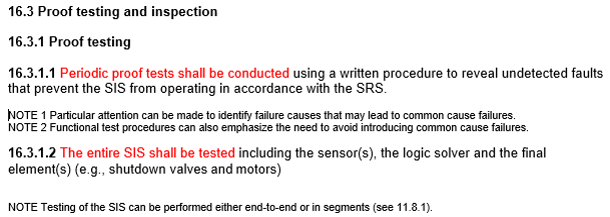
    2. Proof Test: a SHALL requirement in IEC 61511“IEC 61511-1: 2016, 16.3.1” clearly states Proof Test is a SHALL requirement for the entire SIS including sensor(s), the logic solver and the final element (s).
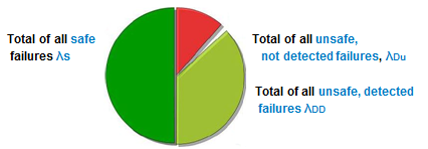
    3. Why Proof Test?                                                                                                                                                               Safety functions, like all other functions,  are associated with failures, thus we need to understand and manage their failures.Analysis λDu (Dangerous/unsafe undetected failure) really bothers us: it will  make that the safety system cannot perform the desired action.Since λDu cannot be detected by diagnostics, then how to control it?

      Proof Test shall be performed to reveal the λDu .  It is just like the mock test in school, which helps the students to reveal their knowledge gap which cannot be identified by themselves (undetected) while will fail them in the coming major examinations (dangerous).


    4. What is Proof Test ?In practice 100% of “as new” condition is not achievable for other than low-complexity safety-related systems. But this should be the target.As a minimum , all the safety function which are executed are checked according to the safety requirements specification.
    5. When and How to Proof Test ?Phase 3: SIS Safety Requirement Specification (SRS)

      Requirements relating to Proof Test Interval, Proof Test Implementation and functions enabling Proof Test…

      Phase 4: SIS Design and Engineering

      Design for appropriate proof testing and if necessary online proof testing…

      Phase 5: SIS Safety Validation

      Safety Validation shall include proof test…

      Phase 6: SIS Operation and Maintenance

      Planning and procedure of Proof Test shall be developed for each SIF…

    6. TÜV  Rheinland & Functional Safety
      • TÜV Rheinland is a well-recognised certification body for the Functional Safety Products, Functional Safety Applications and Functional Safety Management System.
      • TÜV Rheinland Functional Safety Training Program is the only worldwide extended vocational training program in the area of Functional Safety where knowledge and competencies are approved of by a third neutral party and where certificates are issued.
      • As for the process industry sector, our functional safety service covers all safety life-cycle phases based on IEC 61511:2016 and IEC 61508:2010.
      • Local (Singapore) contact: info@sin.tuv.com; +65-67990339


  • Safety Case Assessment Guide regarding Safety Instrumented Systems and IEC61511

    Based on Safety Case Assessment Guide by MHD.

    For Source

    For technical discussion:  

    3. Q:  Safety Case Assessment Guide requires MHIs to demonstrate competency in SIL level
    determination, SIS design and maintenance of EC&I systems. Does competency refer to specific
    functional safety competencies e.g. functional safety certifications, functional safety? Or would
    competence gained through on-the-job-training and work experience in relevant areas such as
    operation / maintenance / process safety and design be acceptable?

    A: Relevant staff must have good understanding of the EC&I systems in order to implement the
    requirements and maintain the systems.
    To demonstrate this, MHIs could use a Training – Core Competency Matrix, which matches
    training and experience to competencies needed for SIL implementation, SIF design, installation
    and maintenance. The demonstration should include how the MHI determined the level of
    understanding, training and education needed to perform those tasks.
    Functional safety certification is not a requirement but would be useful for the demonstration of
    EC & I competency.

    4. Q: Can third parties be engaged for EC&I activities?
    What proof/documentation is required in the safety case to demonstrate that the third party is
    competent to do the work, especially for past projects?

    A: Yes, third parties can be engaged.
    The MHI will need to demonstrate competency for third parties e.g. relevant competencies and
    experience in proof testing and SIS maintenance; basic understanding and training in functional
    safety, especially in requirements for record keeping and SIS proof test procedure.

    5. Q: What proof/documentation is required in the safety case to demonstrate survivability of critical
    utilities and adequacy of backup e.g. UPS?
     Are there standards/guidelines for utilities?
     Is an instrument designed to fail safe on loss of utilities good enough?
     Can MHIs adopt in-house guidelines instead of IEC61511?

    A: There are a range of codes, standards, good engineering practices and guidelines for the
    design/maintenance of utilities that MHIs can take reference from.
    Examples of critical utilities that could impact on safety are compressed air, N2, steam etc. In the
    safety case, MHIs should describe the utilities, their sources, how loss of utility is detected and
    actions taken upon loss detection. Information on utility specifications (e.g. compressor capacity),
    availability of backup systems, utility recovery, maintenance, inspection and testing should be
    provided. Documentation such as test records and diagrams would support demonstration in the
    safety case.
    Designing fail-safe instruments is good engineering practice and enhances reliability. However,
    the use of fail-safe design does not remove the need for utility survivability. Instead, it should be
    seen as a complement to utility design. The SIS should comply with IEC61511.
    MHIs that adopt in-house guidelines for non-SIL control must demonstrate that in-house
    guidelines are comparable to good industry engineering practices and guidelines

    6. Q:  Does Safety Case require MHI to apply IEC61511 to:
    – relay based systems, PLC and DCS with loops used for safety protection
    – general alarm systems and Priority 1 Alarm systems used for safety protection

    A: All systems deemed to be SIS and SIL-rated should adhere to IEC61511. For alarm management,
    refer to EEMUA 191.
    Beyond the scope covered by these standards, good engineering practices shall apply. For
    example, selection and placement of detectors should be considered and could be addressed by
    detector mapping.

    7. Q: What proof/documentation is required in the safety case to demonstrate adequacy of non SILrated system?

    A: The safety case should include the identification of SIFs, SRSs, inspection records etc. MHIs can
    refer to HSE’s Operational Guidance on “Management of instrumented systems providing safety
    functions of low / undefined safety integrity”.

    8. Q:  Do MHIs need to adhere to all requirements in IEC 61511?

    A: MHIs could determine and implement the relevant requirements. However, if the MHI claims to
    comply with IEC61511, all requirements in the standard will need to be complied with.
    MHIs adopting alternative standards will need to provide justifications.

    9. Q: IEC 61511, Section 8.2.4 calls for “A security risk assessment shall be carried out to identify the
    security vulnerabilities of the SIS”. Security risk assessment is new for the process industries in
    Singapore. What is the timeline for MHIs to complete the assessment?

    A: Safety case covers industrial risks that could lead to major accidents. Although security is beyond
    the scope of SCAG, MHIs should ensure that their systems are secure and safe from cyber
    attacks. Currently, demonstrations of security and cyber attack prevention are not required in
    safety case.

    10. Q: Fire and Gas detection has been taken out of the scope of IEC 61511. The general understanding
    is that the PFD for detectors can be influenced by external environmental conditions (e.g. wind
    direction), thus, SIL rating of detectors would not be sufficient. Would it be acceptable to use
    detector mapping to demonstrate sufficient coverage by detectors of a SIF, as part of SIL
    verification?

    A: F&G systems is within the scope of IEC61511. Detector mapping is good practice to demonstrate
    sufficient detection coverage.
  • WSH (MHI) Regulation survey for one research project by SIT

    A very good day to you. My name is Jasmine and I’m an undergraduate from Singapore Institute of Technology (SIT), pursuing a degree with honors in Pharmaceutical Engineering. Currently, I am doing a research project on the new workplace safety and health (WSH) regulations targeted for Major Hazards Installations (MHI) that was released last September – WSH (MHI) Regulation. The objective of my project is to come up with a guideline to help the process industry in Singapore understand the regulatory requirements better so as to utilize/apply the company’s functional safety systems to meet those requirements.

    Other than information on the new regulation and how to meet the requirements, the guideline will also include a study of the best relevant functional safety engineering practice from other countries as well as local functional safety practices.

    In order to gauge how useful the guideline will be for the industry, this survey targets to gather opinions of professionals working in the process industry. All feedback will be greatly appreciated and thank you for taking your time to provide your valuable input.

    https://goo.gl/forms/G0ZNwCOzwX5Wmeww2


  • Why Safety Case Symposium and why Singapore?

    SafetyCase.SG is aware that the first international safety case symposium is right now calling for paper and ready for registration.

    Event:  Safety Case Symposium 2018

    Date:  14-15 March 2018

    Venue: Singapore

    Why Safety Case Symposium? 

    Since the Safety Case Regime was established in the UK, the regulators of various countries (e.g. Denmark, the Netherlands, Australia, Brunei, and Singapore) have adopted similar regimes for their Major Accident Hazard Facilities.  There is a great need of a unified platform for global cooperation and discussion for the international safety case stakeholders. 

    What is Safety Case Symposium? 

    The Safety Case Symposium is the dedicated platform where global stakeholders of safety cases come to share, learn and discuss Safety Case related topics.

    Why Singapore? 

    1. Singapore is geographically  located in the center of Asia Pacific.
    2. It’s well known as the hub for international events, with easy visa access.
    3. Singapore is well known for its efficient excellent cooperation model among government, industry, education and research institute.
    4.  Singapore is among those countries who have adopted Safety Case Regime.

    Why 2018? 

    The best time to have this symposium may be  about 10 years ago. The second best is to have it in 2018.

    What is its theme for this symposium 2018? 

    Safety Case Symposium 2018, is themed Technologies, Methodologies and Regulations.

    What topics will be covered in this Symposium? 

    Safety Case Technologies, Methodologies and Regulations.

    Who should attend? 

    Safety/security regulators, process industries or other Major Accident Hazard Facilities, Safety professionals,  Safety services providers, education and research institutes, standards development bodies, engineering communities and other relevant stakeholders of safety case regime.

    What is its logo about? 

    1. Blue, as its general impression, is a color of safety and reliability.
    2. Circle, as its shape, symbolizes the infinity and openess.
    3. The different component and colors inside the circles, indicates risk factors and safety measures.
    4. S, inside the circle, stands for Safety.
    5. Taiji structure, indicates the balancing between Action and Risk.
    6. Overall, Safety is an art of balancing risks and actions.

    Who are the technical partners? 

    TUV Rheinland and Singapore Institute of Technology(SIT).

    Where to register for a seat? 

    Please Register at its website.

    Or use Safety Case Symposium 2018 flyer Verion 1

    Is there any discount price for SafetyCase.SG readers? 

    Yes, please use the referral code of “safetycase.sg”, and you’ll enjoy 15% off to its prevailing price.

    How to submit a paper for presentation?

    Please refer to attached file: (SafetyCaseSymposium 2018 – Call for Papers )

    Alternatively, go for the event’s web page of Call for Papers.

    Please take note of some its key timeline:

    • Receipt of abstracts: by January 12, 2018
    • Notification of acceptance: by January 22, 2018
    • Receipt of final papers and presentations: by February 22, 2018

    Any requirement  on the papers? 

    The presented topics will cover developments and trends of state-of-the-art technology, best engineering practices, in-depth methodology argument, latest regulations/standards update, or other relevant topics in Safety Case in the context of Singapore and/or global market.

    How can i be a partner of this event? 

    Please contact the event organizer. 


  • Registration of Stakeholders’ Dialogue Session on Draft of New Singapore Standard on Fire Safety for Laboratories Using Chemicals

    The Draft of the new Singapore Standard on Code of practice for the fire safety for laboratories using chemicals is scheduled for public comment from 15 Dec 2017 to 16 Feb 2018 at https://www.spring.gov.sg/Building-Trust/Std/PC/Pages/share-your-views.aspx


    To view draft standard and provide your comments, please refer to URL link: https://www.singaporestandardseshop.sg


    This Stakeholders’ Dialogue Session on Draft of new Singapore Standard on Code of practice for the fire safety for laboratories using chemicals is organised by the drafting committee (Working Group on Fire Safety for Laboratoires) which is under the purview of the Technical Committee for Petroleum Processes and Products. This Dialogue Session is held during the public comment period to gather technical feedback from stakeholders and it also provides the opportunity for stakeholders to seek clarification on the draft standard through this face-to-face dialogue session.


    The new Singapore Standard on Code of practice for the fire safety for laboratories using chemicals is targeted for completion in Q1 2018.


    Programme in Brief:


    • Introduction to Technical Committee for Petroleum Processes and Products
    • Introduction of draft SS on Fire Safety for Laboratories using Chemicals
      • Background
    • Presentation of draft SS on Fire Safety for Laboratories using Chemicals
      • Laboratory unit classification, design and construction
      • Laboratory ventilation systems and hood requirements
      • Compressed and liquefied gases
    • Q & A


    Details of the event are as follows:


    Date:                23 Jan 2018 (Tues)

    Time:                2pm to 4.30pm (Registration at 1.30pm)

    Venue:              JTC Theatre (Level 2)

    8 Jurong Town Hall Road, #25-04, The JTC Summit
    Singapore 609434


    Registration :    FREE


    Seats are limited and would be on first-come-first serve basis.


    For more information on the programme, please refer to the attached brochure. To register, please click on the weblink below: http://www.scic.sg/index.php/events-a-activities/events-sdo/event/289-stakeholders-dialogue-session-on-draft-of-new-singapore-standard-on-fire-safety-for-laboratories-using-chemicals

  • 1st ISA Analysis Division Singapore Symposium 2017 held on 6th Dec 2017

    Event: 1st ISA Analysis Division Singapore Symposium 2017

    Venue: One Farrer Hotel & Spa-Singapore

    Date: 6th Dec 2017

    Best Practices for Analytical Systems

    1.  Increasing operational efficiencies and safety in sulfur plants, with UV and TDLAS analyzers by Michael Gaura
    2.  Cyclone Technology protects analyzer systems for unrivalled reliability and tops productivity by Benson Loh
    3.  Advantages of Using Raman Spectroscopy to Monitor Key Gasoline Blending Parameters by Lee M Smith
    4. Best Practices For Analyzer Systems In Motor Gasoline Blending Operation by Robert Hegger

    Emission Monitoring & Reporting

    1.  How to make Continuous Emission Monitoring Systems (CEMS) more affordable by Thomas Weyrauch
    2.  Emission monitoring applications enabled by cascade lasers by Peter Geiser

    Innovation in Analytical Techniques

    1.  Naphtha Steam Cracking (NSC) Unit Optimization: The Use of Robust On-line Optical Spectroscopy for the Real-time Optimization of Steam-cracking Furnace Operation by Jesper Yip
    2. New Physical Property Analyzer rapiDist-4 for fast online control by Stefanie Koch
    3.   A New Method for LNG Energy Determination by Tony Wimpenny
    4. Technological Advancements in Ethylene Cracking Sample Probes by Michael Jenkins
    5.  Using a Vibrating type Viscometer to Optimize Process Control and Cut Down Production Costs by Ben Chia
    6.  LPG Measurements by Suncor & GWI-Control You Can Measure by Debra Hall
    7.  Process Analytics Using Quantum Cascade Laser by Koh Yee Tiong
    8.  Innovations in Gas Sampling for Improving Accuracy and Reliability of Analytical Results by Tony Wimpenny
    9.  Coatings that improve the reliability, stability and performance of sampling systems used in analysis of ammonia and NOX compounds by Mark Lawrence


  • NEA Dialogue session 2017 held on 29th Nov 2017 at SPGG

    SCIC-NEA DIALOGUE SESSION 2017


    Date : 29 Nov 2017 (Wednesday)
    Time : 2.00pm to 5.00pm (Registration at 1.30pm)
    Venue : Singapore Polytechnic Graduates’ Guild (SPGG),

    Carnation Room

    1010 Dover Road, Singapore 139658

    PROGRAMME OUTLINE


    Time Items
    1.30pm Registration
    2.00pm – 2.10pm Welcome Remarks by NEA

    (by Mr Ram Bhaskar, Director-General, Environmental Protection Division, NEA)

    2.10pm – 2.15pm Welcome Remarks by SCIC

    (by Mr Akira Yonemura, SCIC Board Director / Regulatory Affairs Committee

    Sponsor)

    2.15pm – 2.25pm SCIC Introduction

    (by Mr Au Wing Kuen, Deputy Chairperson, SCIC Regulatory Affairs Committee)

    2.25pm – 3.30pm NEA’s Sharing Session


    1.       Progress of Singapore Sustainable Blueprint

    (by Mr Zhang Kang En, Assistant Director, Environmental Protection Policy Department, NEA)


    2.       Energy Conservation Act – Improving Energy Efficiency in the Industrial Sector

    ·         Key Findings of 2015 Energy Use Report and Energy Efficiency Improvement Plans

    ·         New Measures under the Energy Conservation Act

    (by Mr Shaun Yap, Engineer, Energy Efficiency and Conservation Department, NEA)


    3.       New Licensing Regime for General Waste Disposal Facilities

    (by Mr Ng Tiong Wei, Senior Manager, Waste and Resource Management Department, NEA)


    4.       Hazardous Substances Licensing Control

    ·         Proposed Control of Hydrofluorocarbons (HFC) under EPMA

    (by Ms Lim Kai Yun, Scientific Officer, Pollution Control Department, NEA)

    ·         Proposed Control of New Hazardous Substances

    (by Ms Tracy Toh, Scientific Officer, Pollution Control Department, NEA)

    3.30pm – 4.10pm Q & A Session
    4.10pm – 4.40pm Teabreak & Networking
    5.00pm End of Event

    Presentation slides for download:

    1. SCIC – Advocacy Efforts

    2. Progress of Singapore Sustainable Blueprint-by Zhang Kang En-Assisstant Director

    3. Energy Conservation Act-Improving Energy Efficiency in the industrail sector-by Shuan Yap-Engineer

    4. New Licensing regime for general waste disposal facilities-by Ng Tiong Wei-Head of Waste Facilities Regulations

    5. Hazardous Substances Licensing Control-Proposed Controls of Hydrofluorocarbons Under EPMA-by Lim Kai Yun-Scientific Officer

    6. Hazardous Substances Licensing Control-proposed control of new Hazardous substances under EPMA-by Tracy Toh-Scientific Officer

  • SCDF dialogue session 2017 held on 20th nov 2017 at SPGG

    SCIC-SCDF DIALOGUE SESSION 2017


    Date : 20 Nov 2017 (Monday)
    Time : 9.30am to 12.00pm (Registration at 9.00am)
    Venue : Singapore Polytechnic Graduates’ Guild (SPGG),

    Carnation Room

    1010 Dover Road, Singapore 139658

    PROGRAMME OUTLINE


    Time Items
    9.00am Registration
    9.30am – 9.40am SCIC Introduction

    (by Mr Leendert van Dijk, SCIC RA Committee Chairperson)

    9.40am – 9.45am Brief Update on Standards relating to SCDF – Under SDO@SCIC

    (by Ms Sen Wan Zhen, Secretariat Support for TC for Petroleum Processes and Products)

    9.45am – 10.30am SCDF’s Sharing Session


    1.       Sharing of Fire Statistics (Jan – Sep 2017)

    (by MAJ Rashid, Investigation Support Team Leader, SCDF)


    2.       Sharing of Fire Incidents

    (by MAJ Huang Weikang, Commander Tuas View Fire Station, SCDF)


    3.       Sharing of Common Fire Safety Non-Compliances at Industrial Premises

    (by CAPT Ong Kok Ping, Team Leader, Fire Safety & Shelter Enforcement)

    10.30am – 11.00am Industry’s Sharing Session


    1.       Emergency Response Program Sharing

    (by Mr Cheah Hoong Chuang, HSES Manager, Eastman Chemical Singapore Pte Ltd)


    2.       Sharing of Good Practices – SME Perspective

    (by Mohamed Salleh, LTH Logistics (S) Pte Ltd)

    11.00am – 11.40am Q & A Session
    11.40am – 12.00pm Teabreak & Networking
    12.00pm End of Event

    For slides, please download:

    1. Leedert Van Dijk-SCIC Advocacy Efforts
    2. Sen Wan Zhen-Brief Updates on Standards Relating to SCDF
    3. Major Rashid Mohd Noor-Fire Statistics & Case Studies on Fires involving Waste Management Facilities
    4. Major Huang Weikang-Sharing of Fire Incidents in Waste Managment Industry
    5. Captain Ong Kok Ping-Common Fire Safety Enforcement Findings
    6. Mohamed Salleh- Sharing of Good Practices from SME Perspective